How BIM and AI are redefining efficiency, scale, and intelligence in construction
The construction industry is under pressure from every direction. Costs are risig faster than margins. Skilled labor is becoming harder to find. Sustainability targets are stricter each year. At the same time, clients expect faster delivery, higher quality, and full transparency throughout the project lifecycle.
Trying to meet these expectations with traditional workflows is no longer realistic. Fragmented drawings, manual coordination, latestage problem solving, and disconnected data create waste that the industry can no longer afford.
This is why Building Information Modeling is not just a technological upgrade. BIM is the only viable way to build more with less. And when BIM is combined with artificial intelligence, it becomes a system that does not just represent buildings, but actively improves how they are designed, built, and operated.
The Real Cost of Traditional Construction
Most inefficiencies in construction are invisible until it is too late. Design conflicts discovered on site. Overordering of materials to avoid risk. Delays caused by missing information. Rework that is accepted as normal rather than questioned.
These problems share a common root cause: decisions are made with incomplete or outdated information.
Traditional 2D documentation fragments reality into isolated views. Each discipline works in parallel, often based on assumptions rather than shared truth. Coordination becomes reactive, and every correction consumes time, money, and energy.
Building more with less is impossible in this environment. The system itself generates waste.
BIM as a Single Source of Truth
BIM fundamentally changes how information flows through a project. Instead of drawings that describe a building, BIM creates a data-rich digital representation of it.
Every element exists once and is understood by all disciplines. Geometry, quantities, materials, performance data, and relationships are embedded into the model. When something changes, the impact is visible immediately.
This shared digital environment eliminates many of the hidden inefficiencies that inflate project costs:
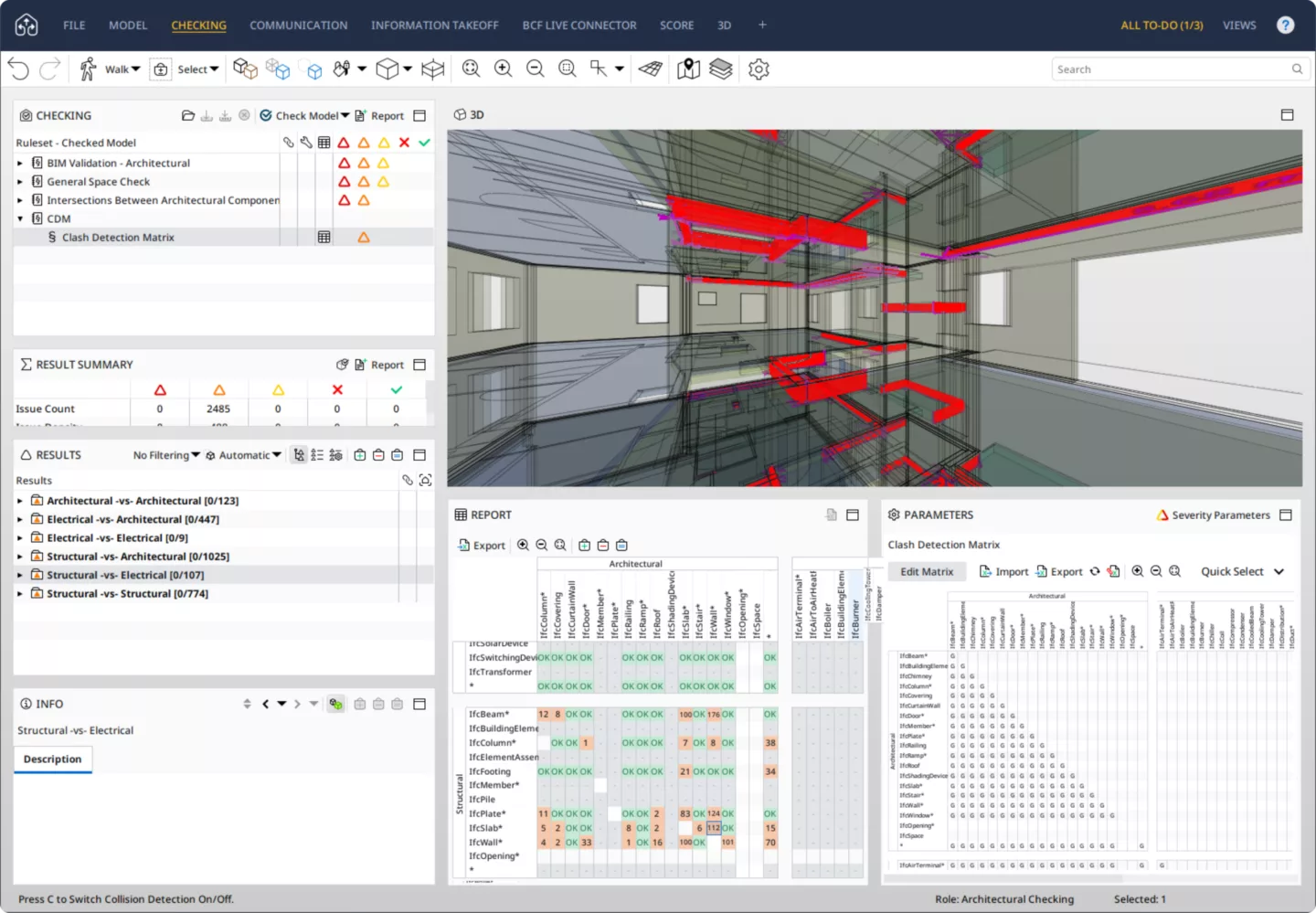
- Clash detection replaces on site problem solving
- Quantity takeoffs are generated directly from the model
- Design changes propagate automatically across all views
- Coordination happens early, when it is still cheap
- BIM does not reduce effort by asking people to work harder. It reduces effort by removing unnecessary work altogether.
From Coordination Tool to Productivity Engine
BIM is often described as a coordination tool, but this understates its strategic value. At scale, BIM is a productivity engine.
A well-structured model allows teams to test scenarios before committing resources. Construction sequencing can be simulated. Logistics can be optimized. Risks can be identified and mitigated while they still exist only in the digital world.
This ability to explore options without physical consequences is what enables building more with less. Decisions become cheaper, faster, and better informed.
Instead of reacting to problems, teams design them out of the project.
Where AI Changes the Equation
While BIM creates structure, AI introduces intelligence.
Modern BIM models contain vast amounts of data. On their own, these datasets are valuable but underutilized. AI systems can analyze this information at a scale and speed no human team can match.
This is where the real transformation begins.
AI can identify patterns across hundreds of projects, revealing which design decisions lead to cost overruns, delays, or performance issues. It can predict clashes before they occur, optimize layouts for constructability, and suggest alternatives based on past outcomes.
In practice, this means fewer iterations, fewer errors, and fewer surprises.
Designing with Foresight, Not Guesswork
Design decisions made early in a project determine the majority of its lifecycle cost. Yet these decisions are often based on experience, intuition, and incomplete data.
AI-enhanced BIM replaces guesswork with foresight.
By learning from historical project data, AI can estimate cost, carbon impact, and construction complexity at early design stages. Designers receive immediate feedback on the consequences of their choices, long before those choices become expensive to change.
This feedback loop allows teams to achieve better outcomes using fewer resources, simply by making smarter decisions earlier.
Automating the Repetitive, Preserving the Human
One of the most overlooked benefits of BIM and AI is their impact on human work.
Construction professionals spend a significant portion of their time on repetitive tasks: checking drawings, updating schedules, verifying quantities, and coordinating information across platforms. These activities add little strategic value but consume enormous effort.
Automation within BIM workflows removes this burden. AI can handle rule-based checks, data validation, and routine coordination. This frees professionals to focus on design quality, problem solving, and stakeholder collaboration.
Building more with less is not about reducing people. It is about allowing people to operate where they create the most value.
Sustainability by Design, Not by Correction
Sustainability targets are often addressed late in the project, when design flexibility is limited and costs are high. BIM changes this by embedding performance data directly into the design process.
Energy use, material quantities, and lifecycle impacts can be analyzed continuously. AI can optimize designs for lower carbon footprints, reduced waste, and better long-term performance.
Instead of correcting problems after construction, teams prevent them during design.
This approach aligns economic efficiency with environmental responsibility. Less waste, fewer changes, and better-performing buildings are not trade-offs. They are outcomes of intelligent systems.
Digital Twins and the Extended Lifecycle
The value of BIM does not end at handover. When models are maintained and enriched with operational data, they evolve into digital twins.
AI-enabled digital twins allow building owners to monitor performance, predict maintenance needs, and optimize operations in real time. Systems learn from usage patterns and adjust accordingly.
This extends the principle of building more with less beyond construction into decades of operation. Fewer failures, lower operating costs, and longer asset life are achieved through intelligence, not additional resources.
The Strategic Advantage of BIM Maturity
Organizations with high BIM maturity consistently outperform those without it. Not because they use better software, but because they think differently about information.
They invest in data quality, standards, and workflows. They understand that BIM is infrastructure, not overhead. When AI is layered on top of this foundation, the advantage compounds.
Projects become more predictable. Teams become more efficient. Risks are reduced systematically rather than heroically.
In a competitive market, this is no longer optional.
The Only Scalable Path Forward
The construction industry cannot solve its challenges by working harder. There are limits to labor, budgets, and natural resources.
The only scalable solution is intelligence.
BIM provides the structure that allows complexity to be managed. AI provides the insight that allows complexity to be reduced. Together, they form the only realistic path to building more with less.
Faster delivery without burnout. Higher quality without excess cost. Sustainable outcomes without compromise.
The future of construction belongs to those who stop treating BIM as a requirement and start treating it as a strategy.